
Waking at night to go to the toilet? It is not from too much water.
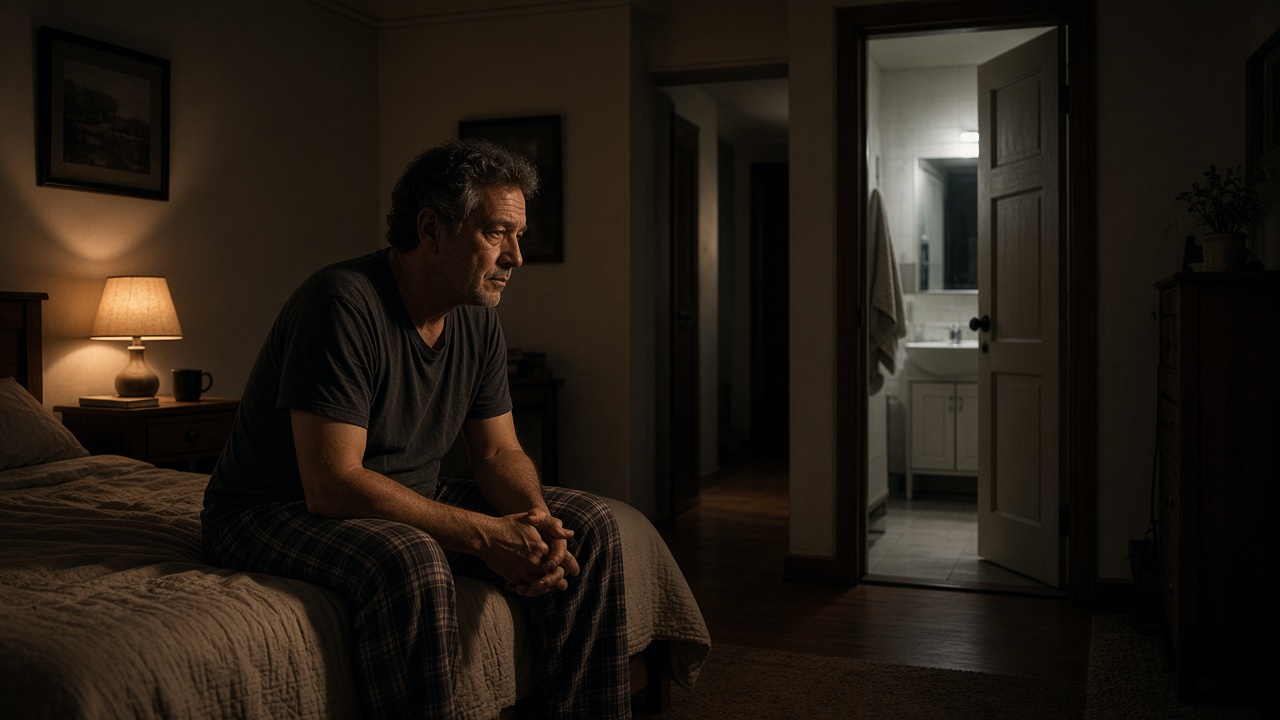
The first thought is always the same: I drank too much. The second: it is age. Both can be partly true, and both hide a mechanism urology guides have described for years. Nocturia — getting up at night to pass urine — is not one symptom of one cause. It is a pile-up of habits, kidney rhythm and what happens to the bladder after forty.
The kidneys do not switch off at 23:00. If you drink little during a hot day in Pretoria and then catch up with two glasses and a beer after the news, the body shifts diuresis into the night. That is not too much water in total. That is bad timing. Urology societies have long advised cutting drinks two to three hours before bed and moving water to the morning and midday.
Caffeine and salt do more than a glass
Coffee after 16:00 works twice: it stimulates and it is a diuretic. Black tea and cola do the same. Salt from dinner — biltong, cheese, chips in front of the screen — holds water in the tissues. At night, when you lie down, some of that water returns to circulation and fills the bladder. You wake and blame “too much water”, though in the day you had two coffees and a salty sandwich.
Alcohol in the evening deserves its own paragraph. Ethanol suppresses vasopressin, the hormone that should limit urine production at night. A beer at 21:00 during a match is not only fluid volume. It is a signal to the kidneys: work now.
The bladder and the prostate change with age
In many men after 50 the prostate enlarges. That is a common, almost statistical process, not a verdict and not a reason to diagnose yourself from a website. An enlarged gland can make it harder to empty the bladder completely. Then you get up, pass little, and an hour later you go again. That is not too much water. That is residual urine the bladder did not finish.
Diabetes, sleep apnoea, blood-pressure tablets taken at night, simply short sleep — the list is long. So this text does not end with a prescription. It ends with a checklist you can run for a week before you book a GP — or precisely so you book with notes.
Heat is not a licence to drink at 21:00
South African summers punish people who “save” water for the evening. Sweat in the day, then a litre before bed, is a classic recipe for 01:30. Keep a bottle on the desk from 07:00. In Durban humidity or Cape south-easters, sip steadily until 17:00. After that, small sips only. If you train after work, finish the recovery drink early, not in the driveway at 20:30.
A week of observation, not panic
- Note the hour of the last coffee, the last alcohol and the last glass.
- Note how many times you get up and whether the stream is weak or full.
- Move 80% of fluids to 07:00–17:00.
- Cut salt after 18:00 for seven days and see if the nights are quieter.
- If there is blood, fever, flank pain, or you cannot pass urine — this is not an essay, this is emergency care.
Pelvic-floor exercises do not repair kidneys. They help some men with control when coughing and standing up. Herbal tea does not replace a check-up. It can replace a third coffee.
Salt versus water: what really fills the bladder at night
A glass at 21:00 is visible. Salt from supper is invisible. Biltong, chips, yellow cheese and ready sauces hold water in tissues all evening. When you lie down, some of that water returns to the blood and the kidneys. You wake with a full bladder and scratch “hydration” off the list, though in the day you drank too little and in the evening you ate too salty.
For seven days do a simple test: 80% of fluids by 17:00, salt after 18:00 only in moderation, no chips to the series. Write the nights down. If nothing changes, you have a concrete note for the doctor, not a vague anger at water.
A week without heroism
Monday–Friday: last coffee by 15:00. Bottle on the desk morning and noon, after 17:00 sip sparingly. Dinner: pap or potato, a vegetable, egg or fish, without a second round of processed meat. Ten minutes of walking after lunch. Into bed at a similar hour.
Weekend: if there is beer, earlier, not until midnight. With beer — seeds or nuts, not a bag of chips. Sunday evening returns to the working rhythm, not “one more episode and tea at 22:00”.
Medicines, sleep apnoea and the notes you actually bring
Water tablets and some blood-pressure medicines taken at night will fill the bladder whether your coffee was early or not. Do not stop a prescription because an article mentioned salt. Write the names and the hour you take them. Sleep apnoea — snoring, gasping, a partner who leaves the room — is another reason nights are broken; the bladder is not the only organ on a night shift. A GP can sort which story is yours. A shop cannot.
Your notes for the appointment: last coffee, last alcohol, last large glass, how many times you stood up, whether the stream was a dribble or a full void, salt after 18:00 yes or no. Seven lines on paper beat a vague “I drink a lot of water”.
What “residual urine” feels like in ordinary language
You stand up, you pass a little, you go back to bed, forty minutes later you are up again. The glass of water at 21:00 is an easy villain. The unfinished emptying is quieter. Men describe a thin stream, a stop-start, a feeling that more is left. None of those sentences is a diagnosis. All of them are useful on a GP’s pad. Do not start “pushing harder” because an article mentioned residue. Straining is not a technique. It is a way to irritate a pelvic floor that already had a long day in a chair.
If the stream has been a thread for months, the next object is a clinician, not a stronger tea. The trainer, the mug and the patch do not measure leftover urine. They do not pretend to.
A notebook that takes four minutes a night
Keep a cheap pad by the bed for seven days. Columns: time you went to sleep; times you stood up; weak or full; last coffee; last alcohol; last large glass; salty snack after 18:00 yes/no. In the morning, one line. Do not write an essay. On day eight you have a page. That page is more useful than “I drink a lot of water” in a waiting room.
If you share a bed, ask once whether you snore or gasp. Write that down too. Sleep apnoea and nocturia often travel together. A shop will not sort them. A GP might send you onward. Your job is the note, not the referral letter.
Coffee culture, cola and the office machine
South African offices run on the machine in the passage. The third cup is rarely hunger. It is 15:40 and a meeting. Move that cup to 14:30 or replace it with water or with the afternoon herbal blend — knowing the blend still has green tea. Cola at 16:00 is caffeine plus sugar plus volume. “Diet” cola keeps the caffeine. Iced coffee in a drive-through on the way home is still coffee.
If you drop caffeine for a week and get a headache, that is withdrawal, not proof that nights will stay loud. Give the week its seven days. Then look at the pad.
When to see a doctor instead of reading on
Book if you get up three times every night for several weeks, the stream has been thin for months, prostate cancers run in the family, you are over 50, or 45 with risk factors. Immediately — blood, fever, flank pain, urinary retention, unexplained weight loss. An essay can arrange a week. It cannot look at a prostate.
PSA tests, scans and medicines are a clinician’s tools. This site will not order them for you and will not tell you to skip them. Bring the week of notes. Mention heat, braais, beer hours and sitting. Mention tablets. Then let the person in the room work.
What a full void versus a dribble tells you — and what it does not
A full void at 02:00 after a late litre is often timing. A dribble, a stop-start, a feeling that more is left, then another walk forty minutes later, is a different sentence. Write which one it was. Do not decide in the passage which organ is guilty. Do not push harder because an article mentioned residue. Straining irritates a pelvic floor that already sat in a car. The clinician gets the note. You get the clock for the parts that are still habits.
Some men pass a lot at night and almost nothing in the morning. Some are the opposite. Both patterns are useful. “I pee a lot” is not a pattern. Times plus weak-or-full is a pattern.
The first ninety minutes after the alarm
Drink water with breakfast, not two hours later when the first meeting starts. The day’s 80% begins here. Coffee with food if you want it — this is still the caffeine budget. A large juice is volume and sugar; fruit on the plate is food. If you skip breakfast and then “catch up” with a drive-through and a second coffee at 10:30, you have already spent the morning badly for a night you care about.
The eggs and seeds breakfast exists so the first plate has protein and fat without a salty bun. Sit down. Ten minutes is part of the recipe. Standing over the sink teaches the rest of the day to rush, including the last void.
Afternoon meetings, machines and “I needed it”
The office machine at 15:40 is rarely hunger. It is a calendar. Move the cup to 14:30 or replace it with water or with the Herbal Blend after 16:00 — knowing the blend still has green tea. A third filter coffee because the client was late is still caffeine with a half-life. Cola in the boardroom is caffeine plus volume. “Diet” keeps the caffeine.
Working from home removes the walk to the machine and replaces it with a kettle you control. That is either better or worse. If the kettle becomes coffee at 17:00 because the kitchen is five metres away, put the beans away after 15:00. Ridiculous. Effective. Rooibos after 18:00 is the evening mug. It is still fluid.
Partners, children and a house that does not run on your bladder
A baby, a teenager, a partner on night shift — the house will not go quiet because you read an essay. You can still keep your last coffee, your last large glass, and your pad. You cannot keep a perfect bedtime every night. Write the nights that broke for family reasons so a GP does not treat them as prostate nights. The pad is a filter, not a moral score.
If you share a bed and you get up twice, say so once, calmly, so the other person is not guessing. If they say you snore or gasp, write that down. Sleep apnoea and nocturia travel together often enough that the sentence belongs in the room. A shop will not sort it.
Travel days, funerals, weddings and the week that ignores your clock
You will have days that ignore 15:00. Eat when you can. Drink through the day, not as a litre at 23:00 in a guest room. Skip the minibar. Toilet before bed in a strange house even if you “don’t need to”. The next ordinary Tuesday is where the sequence starts again. One wedding does not cancel a month. A month of weddings is a month of notes that say “event” in the margin.
Funerals and long church hours make people skip water and then drink late. Sip through the day in a bottle you brought. Eat a proper plate when you get home, earlier rather than after the last conversation. This is not disrespect. It is a bladder that will still wake you at 02:00 in a house that is not yours.
Diabetes, tablets and the story that is not “too much water”
Thirst that never quits, sweet drinks all afternoon, getting up many times plus tiredness — that list is bigger than coffee timing. Do not diagnose diabetes from a paragraph. Do mention the thirst and the sweet drinks to a GP. Water tablets taken at night will fill the bladder whether the last espresso was at 15:00 or not. Do not stop them because this article likes mornings. Write the names. Ask when to take them. That conversation is clinical. This page is a clock.
Prostate enlargement is common after fifty and is not a verdict you reach in a browser. Residual urine is a measurement a clinician can talk about. You can only describe the dribble. Describe it. Do not start a herb to “shrink” anything. That sentence does not belong on a wellness site and it does not belong in your kitchen.
A second week of notes when the first week was messy
If you forgot the pad on three nights, you do not have a week. Start again on Monday. If you had a braai on Saturday, keep the line — it is data, not a failure. If every night was a special case, you still have a pattern: special cases. Bring that. A GP would rather see “braai, two beers, three trips” than “I drink normally”.
After two honest weeks, look at caffeine hours and salt hours first. Those are the cheapest experiments. Beer timing is the third. Sitting and a short walk are the fourth. Products sit after that, as metronomes and mugs, not as tests. If two weeks of clock changed nothing and you still get up three times, book. The essay has done its job.
What “emergency” looks like in a bathroom at night
Cannot pass urine. Blood. Fever. Pain in the side that does not match a pulled muscle. Swelling, confusion, vomiting with the inability to void. These are not “wait until Monday” and they are not a herbal mug. Go now. This website will still be here when you have been seen. The sequence of hours is for the nights that are loud and ordinary. It is not a triage tool, but it is honest enough to say when to stop reading.
Unexplained weight loss, bone pain, a stream that has been a thread for months — not tonight’s emergency, still this week’s booking. Bring the pad. Mention family history if you have it. Then let the person in the room work.
Read next: salt and biltong, beer timing, evening habits.
This website is for information about daily habits and wellness products. It is not medical advice and does not replace a doctor. If you have symptoms, see a specialist.